
Beyond Digestion: The Hidden Influence of Abdominal Fascia on Posture, Movement, and Emotional Wellbeing

by Dr. Robin Sharma, Manual Medicine Practitioner and Visiting Master at AyurMa
For centuries, healers have recognized that the abdomen is much more than a place where food is digested. Modern anatomy and physiology continue to reveal that this remarkable region serves as a centre of communication between our musculoskeletal system, nervous system, breathing mechanism, circulation, immune function, and emotional wellbeing.
In my clinical practice, I often meet guests who seek treatment for neck pain, chronic back pain, shoulder stiffness, headaches, fatigue, or poor posture. Surprisingly, many are unaware that the abdomen – and more specifically the fascial system surrounding the abdominal organs – may play an important role in how the entire body moves and feels.
The Body as an Integrated System
As a manual medicine practitioner, I have learned that effective treatment begins by looking beyond the site of pain; we always focus on finding the main source of your problem. The body functions as one integrated system, and restrictions in one region may influence movement and comfort in another.
When most people hear the word “abdomen”, they immediately think about digestion. While digestion is undoubtedly one of its essential functions, the abdomen is also home to an extraordinary network of connective tissue, muscles, nerves, blood vessels, lymphatic channels, and organs that constantly communicate with one another.
Every breath you take, every step you walk, every time you bend, twist, laugh, cough, or even speak, your abdominal structures participate.
The abdomen is never truly at rest. It is constantly adapting to movement, posture, gravity, and emotional stress. This is why osteopathic medicine considers the abdomen not as an isolated compartment but as one of the body’s most important centres of function.
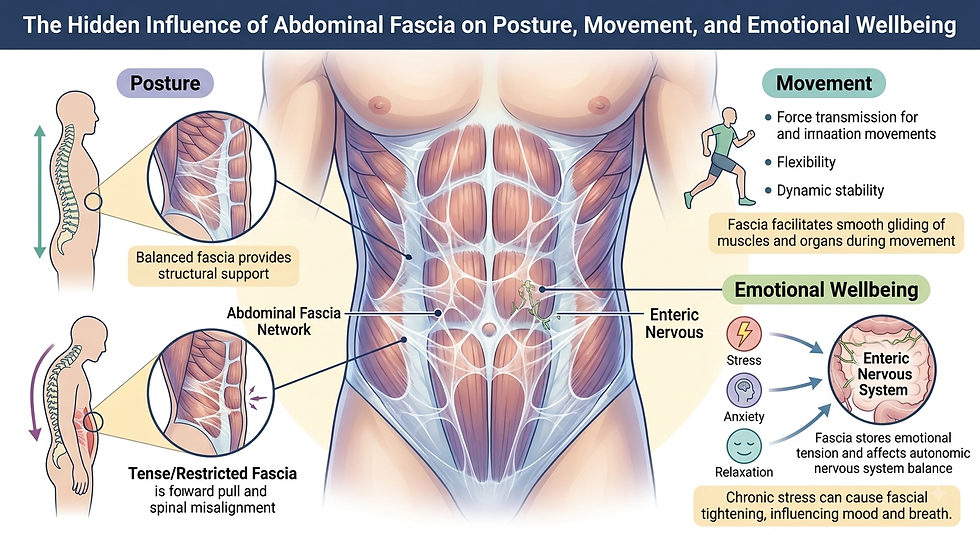
Fascia: The Forgotten Organ of Movement
For many years fascia was viewed simply as tissue that wrapped muscles and organs. Today, researchers recognize fascia as an active, living, three-dimensional connective tissue network that extends uninterrupted from head to toe.
It surrounds every muscle, organ, blood vessel, nerve, joint and bone.
Rather than existing as separate structures, the body is interconnected through this remarkable fascial web. Imagine wearing a perfectly fitted suit made from one continuous piece of fabric. If one section becomes tight, the tension is transmitted throughout the entire garment. The fascial system behaves in a similar way: a restriction in one area may influence movement somewhere entirely different.
For instance, when we look at the abdominal fascia, we discover it forms important mechanical and functional connections between the diaphragm, liver, stomach, intestines, kidneys, lumbar spine, pelvis, hips, rib cage, and even the muscles of the neck.
The Dynamic Relationship Between Fascia and Posture
Posture is not simply determined by muscles. It is the result of continuous interaction between bones, joints, muscles, fascia, breathing, vision, balance and the nervous system.
When abdominal fascia loses its natural mobility – whether from prolonged sitting, repetitive movement, previous surgery, inflammation, injury, pregnancy, emotional stress, or chronic muscular guarding – the body frequently develops compensatory movement strategies.
Over time, these adaptations may contribute to symptoms such as:
Forward head posture
Rounded shoulders
Rib cage stiffness
Reduced spinal rotation
Lower back discomfort
Pelvic asymmetry
Hip stiffness
Altered walking mechanics
Increased muscular fatigue
The body is remarkably adaptable, and it will almost always find a way to keep moving.
The question is not whether compensation occurs, but how much energy the body must expend to maintain it.
The Diaphragm: Where Breathing Meets Posture
One of the most fascinating structures in the human body is the diaphragm. Most people recognize it as the primary muscle responsible for breathing. However, its influence extends far beyond respiration.
The diaphragm connects directly or indirectly with:
The lower ribs
The thoracic spine
The lumbar spine
The abdominal fascia
The psoas muscles
The pericardium surrounding the heart
The connective tissues supporting the abdominal organs
Amazingly, every healthy breath gently mobilizes the abdominal organs, assists circulation, supports lymphatic drainage, helps regulate pressure within the abdominal cavity, contributes to spinal stability, and influences posture.
Unfortunately, modern lifestyles often replace deep diaphragmatic breathing with shallow upper-chest breathing. Stress, prolonged desk work, air travel, emotional tension, chronic pain, and fatigue all encourage this pattern. When breathing becomes inefficient, posture often changes with it.
The Fascinating Conversation Between the Gut and the Brain
One of the most exciting developments in modern medicine has been our growing understanding of the gut–brain axis.
The digestive tract and brain are constantly exchanging information through the vagus nerve, hormonal signals, immune pathways, the enteric nervous system and the gut microbiome.
Our digestive system contains hundreds of millions of nerve cells, earning it the nickname “the second brain.” Although it does not think in the same way as the brain inside our skull, it plays an essential role in regulating digestion and communicating with the central nervous system.
When stress levels increase, many people notice digestive changes. Likewise, persistent digestive discomfort can influence mood, sleep, concentration, and overall quality of life. This relationship is genuinely bidirectional.
Understanding Serotonin
Serotonin is widely known as a neurotransmitter involved in mood regulation, but its biology is far more complex.
Approximately 90–95% of the body’s serotonin is produced in specialized cells within the gastrointestinal tract. There, it helps regulate intestinal movement and participates in signaling between the gut, nerves, and immune system. The serotonin used by the brain is produced separately because serotonin in the bloodstream does not cross the blood–brain barrier.
Even so, the gut and brain remain closely connected. The gut microbiome, inflammatory signals, hormones, sleep, nutrition, physical activity, and stress all interact through the gut–brain axis and can influence how we feel physically and emotionally.
For this reason, digestive health is increasingly viewed as an important part of overall wellbeing.
The Role of Manual Medicine in Abdominal Health
As manual medicine experts we draw on a range of skills including osteopathy, chiropractic, physiotherapy and emotional liberation techniques to give you best possible results in as short a time as we can.
A comprehensive manual medicine assessment may include:
Breathing mechanics
Diaphragm mobility
Rib cage movement
Thoracic spine mobility
Lumbar spine mechanics
Pelvic function
Abdominal wall mobility
Fascial tension
Functional movement patterns
After assessment, we focus on the best possible treatments to help restore more efficient movement within these interconnected systems, allowing the body to function with less mechanical strain.
Many patients describe improvements such as easier breathing, freer movement, better posture, reduced muscle tension, and an enhanced sense of relaxation. Individual outcomes vary, and treatment is always tailored to the person’s condition and medical history.
Healing Beyond Pain
One of the greatest lessons I have learned throughout my career is that healing is about far more than eliminating symptoms.
It is about helping people reconnect with their bodies, breathe more deeply, stand taller, move more naturally, experience less effort during everyday life and regain confidence in movement. When the body moves efficiently, everyday activities become easier, and many people feel more resilient both physically and mentally.
As manual medicine experts, our role is not simply to treat pain. It is to understand how your body moves, identify areas of restriction, and help restore the balance that allows you to enjoy life more fully. Whether you arrive with chronic neck pain, postural fatigue after long-haul travel, reduced flexibility, or simply a desire to optimise your wellbeing, my goal is to provide personalised care that respects both modern science and the remarkable wisdom of the human body.
True health is not merely the absence of disease. It is the freedom to breathe deeply, move effortlessly, stand confidently, and experience life with vitality.
Sometimes, that journey begins by looking beyond the symptoms – and discovering the remarkable connection between the abdomen, posture, movement, and the whole person.
Join Dr. Robin Sharma at AyurMa at Four Seasons Resort Maldives at Landaa Giraavaru from September 9th to October 8th, 2026 and experience his unique integrated approach to support healing at a structural, visceral, and somatic-emotional level.


