
Why Smart People Stop Thinking Clearly

The brain science behind brilliant minds going blank under pressure, and how to bring clarity back.
By Trish Pashazadeh-Allen, Neuroscientist and Founder of GoodBrain
I spend much of my working life with exceptionally clever people. Lawyers who can take apart a 200-page contract before lunch. Bankers who hold dozens of moving variables in their heads at once. Leaders whose judgement is trusted with decisions worth millions.
Yet the question I’m asked most often, in one form or another, is this: “Why can’t I think straight anymore?”
It usually comes quietly, at the end of a session. A senior partner admits she rereads the same email four times without taking it in. A managing director says he snapped at his team over something trivial and can’t work out why. Another confesses that the decisions which once felt effortless now feel foggy, slow and strangely emotional.
None of this is a character flaw, and it isn’t a sign that intelligence is fading. It’s biology. Once you understand what is happening inside the brain, it becomes much easier to do something about it.
The brain’s most brilliant and most fragile region
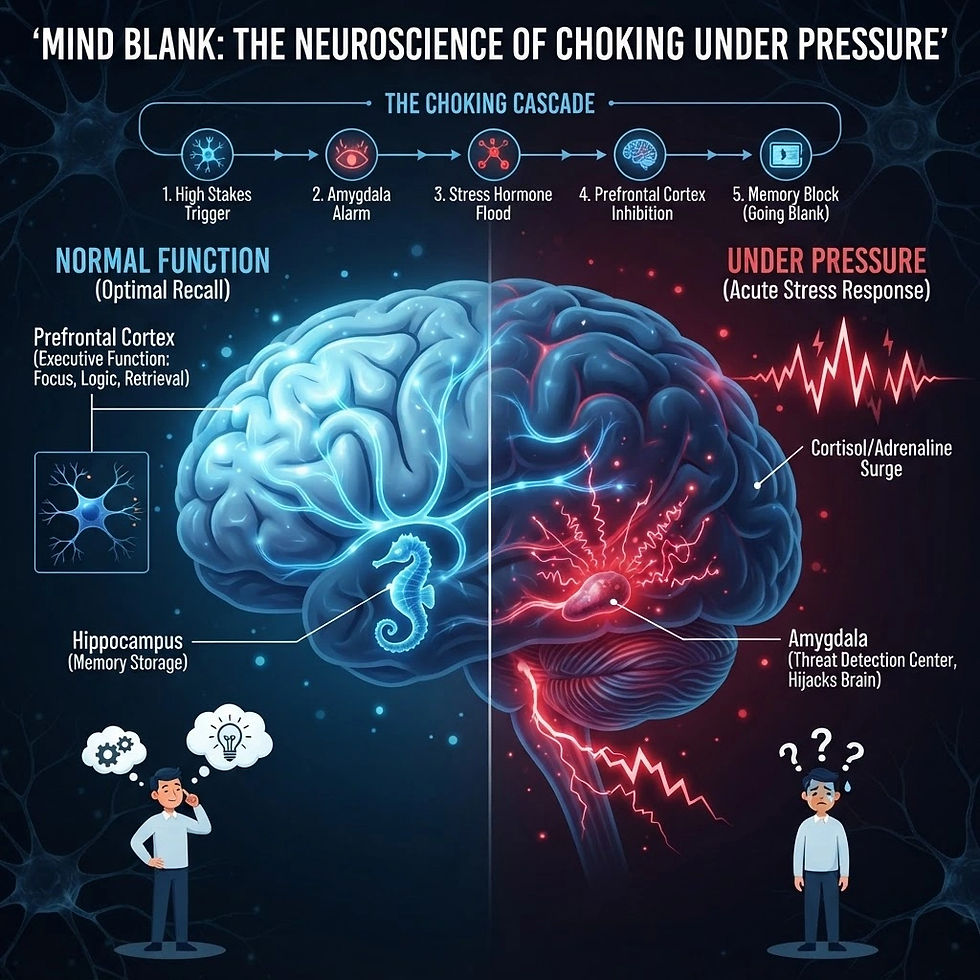
Clear thinking lives largely in the prefrontal cortex, the region just behind your forehead. It is the most recently evolved part of the human brain, and it does the work we most associate with intelligence: planning, weighing options, holding information in mind, controlling impulses and seeing a situation from more than one angle.
It is also remarkably delicate. The prefrontal cortex depends on a finely balanced chemical environment, in particular the right levels of dopamine and noradrenaline. Too little and we feel flat, distracted and unmotivated. Too much, which is what happens under stress, and the connections between prefrontal networks begin to weaken. Neuroscientists describe this as an inverted U: performance rises with moderate arousal, then drops sharply once pressure tips past a certain point.
When that happens, control shifts to older, faster parts of the brain, including the amygdala, our threat detector, and the habit circuits that run on autopilot. From an evolutionary perspective this makes perfect sense. If a predator is charging at you, you don’t need nuanced analysis; you need speed. The problem is that the modern brain can’t tell the difference between a predator and a hostile inbox, a tense board meeting or a relentless run of deadlines.
So the very moments when we most need our sharpest thinking are precisely the moments when the brain is most likely to take it offline.
Why intelligence doesn’t protect you, and can make things worse
It’s tempting to assume that clever people are better protected from muddled thinking. The research suggests otherwise.
Intelligence is superb at building arguments. The trouble is that it builds them just as efficiently for conclusions we have already reached as for ones we’re genuinely testing. Psychologists call this motivated reasoning. In a well-known series of studies by Dan Kahan and colleagues at Yale, people with stronger numerical skills were more likely to misread data, not less, when the correct answer clashed with a belief tied to their identity. Their skill simply gave them better tools to explain away inconvenient evidence.
Expertise adds another layer. Experts are fast because they recognise patterns, and most of the time this is a gift. But pattern recognition can harden into certainty. The more successful we have been, the more we have at stake in being right, and the less likely we are to notice when a situation no longer fits the familiar template.
Add status and pressure to the mix, and the brain’s threat response becomes easier to trigger. Being challenged, being seen to be wrong or losing control of a situation can register in the brain much like physical danger. That is when bright people become defensive, rigid or reactive, and it is often mistaken for arrogance when it is really a nervous system under strain.
The quiet culprits: sleep, overload and never switching off
Beyond acute stress, there are three slower forces that steadily erode clear thinking in high achievers.

Sleep. Research from Australia found that after around 17 to 19 hours without sleep, performance on some tasks was comparable to having a blood alcohol level of 0.05 per cent. The prefrontal cortex is among the regions most sensitive to sleep loss. Brain imaging work has also shown that a sleep-deprived amygdala reacts far more strongly to negative images, while its connection to the calming, regulating prefrontal cortex weakens. In practical terms, a poor night’s sleep makes us both less rational and more emotional at the same time, a difficult combination for anyone making important decisions.
Cognitive overload. Working memory, the mental workspace we use to reason, is surprisingly small. Every unfinished task, unanswered message and background worry occupies a little of that space. Constant switching between tasks carries its own cost as the brain reorients each time. Many of the leaders I work with are not short of intelligence; they are short of available bandwidth.
No white space. Some of our best thinking happens when we’re not trying to think at all. When the mind wanders, a set of regions known as the default mode network becomes more active, helping us connect ideas, reflect on experience and make sense of the bigger picture. This is why insights arrive in the shower, on a walk or while gazing at the sea. High achievers often fill every gap with a phone, a podcast or another task, and in doing so remove the very conditions in which clarity forms.
How to bring your clear mind back
The encouraging news is that the prefrontal cortex recovers quickly once conditions improve. These are the approaches I return to most often with clients, because they are simple, grounded in evidence and realistic for busy lives.

1. Lengthen your exhale. Slow breathing with an out-breath longer than the in-breath helps activate the parasympathetic nervous system, the body’s brake pedal. Try breathing in for four counts and out for six to eight, for two or three minutes. It is one of the fastest ways to lower arousal back down the curve towards clear thinking. Here, the ancient yogic practice of pranayama and modern physiology agree.
2. Name what you feel. Putting a feeling into words, known as affect labelling, has been shown in brain imaging studies to reduce amygdala activity. Simply saying to yourself “I feel under threat” or “I’m anxious about this decision” creates a small but meaningful distance between you and the reaction.
3. Get it out of your head. Write down every open loop before an important piece of thinking. Offloading tasks onto paper frees working memory for the problem in front of you.
4. Protect sleep as a performance tool. Treat it with the same seriousness you would give a critical meeting. Consistent timing, a wind-down period without screens and morning daylight all help regulate the body clock.
5. Build in unstructured time. Walk without headphones. Sit by water. Research on attention restoration suggests that natural environments allow our focused attention to recover in a way that urban and digital settings don’t.
6. Invite disagreement deliberately. Because intelligence can defend almost any position, clear thinking often depends on other people. Ask a trusted colleague to argue the opposite case, or ask yourself: “What would need to be true for me to be wrong?”
Why a place like this matters
There is a reason so many guests tell us that ideas begin to flow after a few days here. On an island, much of the noise falls away. Days follow the rhythm of light and tide rather than notifications. Sleep deepens. The breath slows. The body is cared for, and the mind no longer has to stand guard.
In neuroscience terms, the conditions for the prefrontal cortex to come back online are quietly restored. In the language of Ayurveda and yoga, the system returns to balance. Both describe the same truth: clarity is not something we force. It is something we allow, once we stop working against our own biology.
Smart people don’t stop thinking clearly because they lose their intelligence. They stop because their brains are doing exactly what they evolved to do under pressure. Change the conditions, and the brilliance returns.
Trish Pashazadeh-Allen is a neuroscientist, leadership practitioner and founder of GoodBrain. She works with leading global organisations to translate brain science into practical tools for clearer thinking, resilience and sustainable high performance.


